Product Design
UNIFIED LOGIN
Unified login between health and e-commerce sites
Year :
2023
Industry :
Healthcare and E-commerce
Client :
Walmart
Project Duration :
4 months
Problem Statement
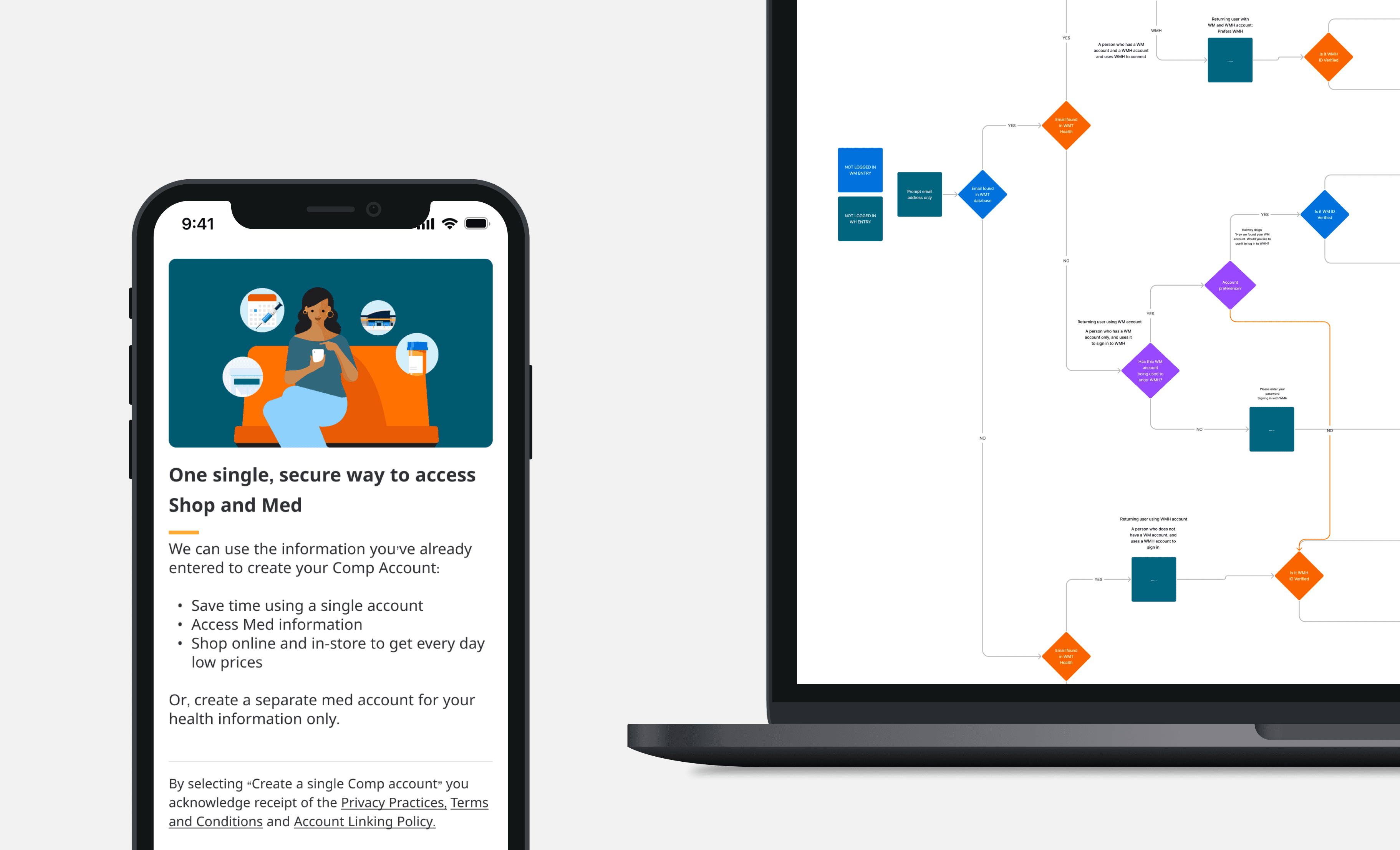
CareSmart’s authentication experience was fragmented across separate retail and health login systems, leading to duplicate accounts, user confusion, and recurring access issues.
The business needed a unified login experience — but consolidation required navigating strict legal, security, and platform constraints, as well as complex access logic across multiple user types.
At a critical entry point of the product, authentication was creating friction instead of trust — and required a compliant, scalable solution that balanced usability with regulatory and technical realities.
Approach
To design a sustainable authentication model, I structured the work across three dimensions: user experience, technical feasibility, and legal compliance.
Scenario Mapping
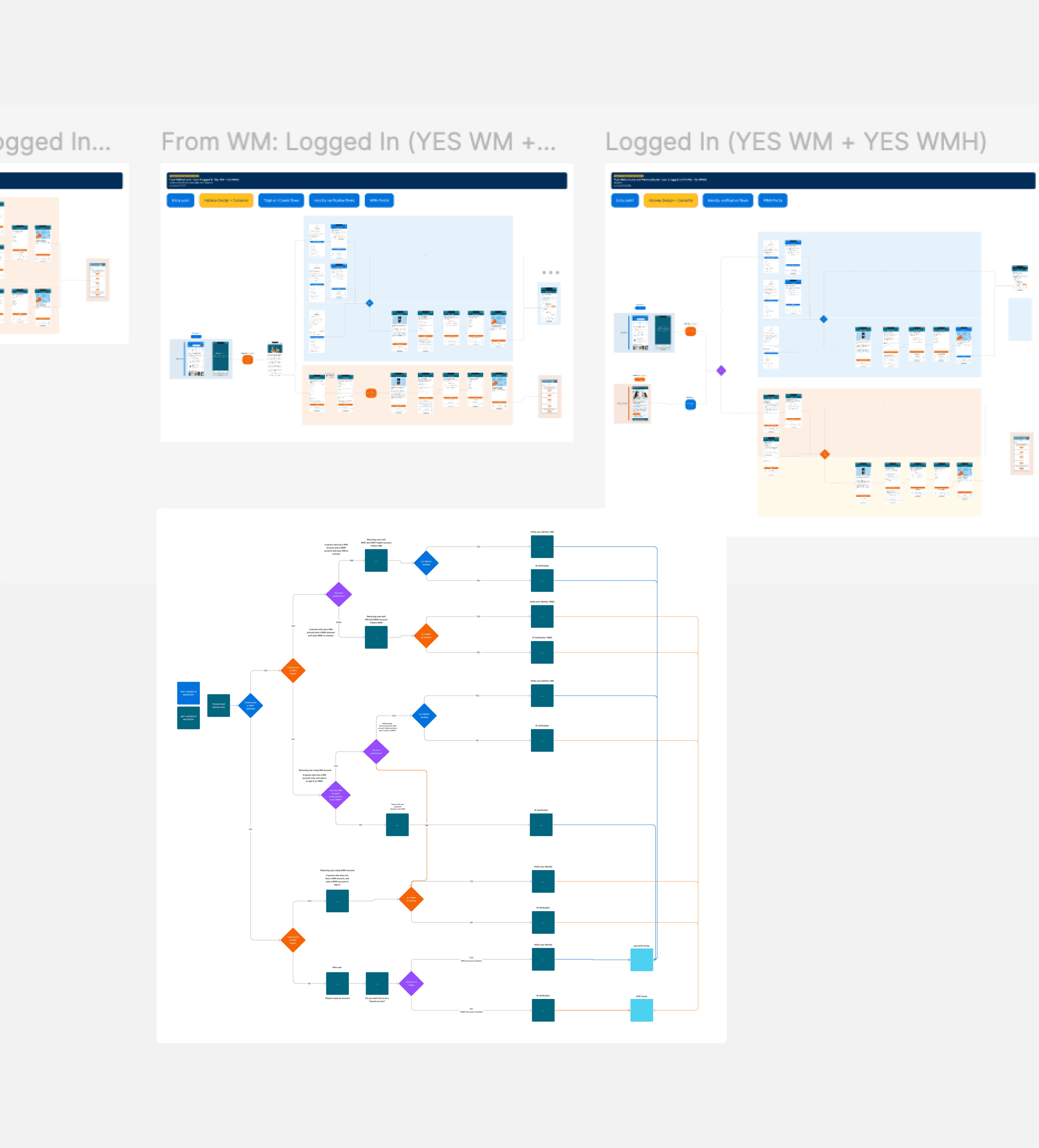
I began by mapping retail and health login flows end-to-end, identifying friction points, edge cases, and system dependencies.
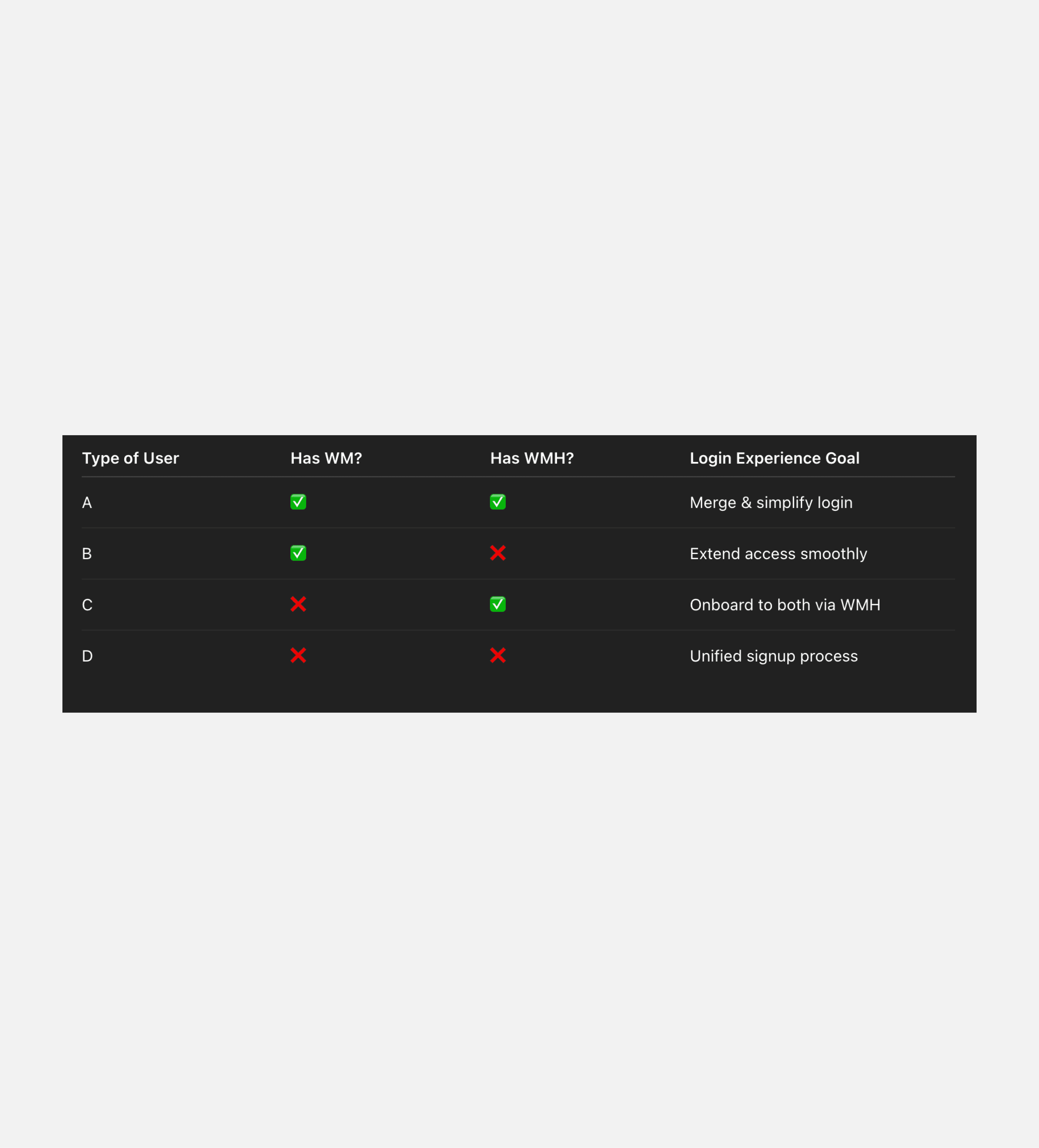
Through this analysis, we identified four distinct user types — each with unique access rules and compliance implications. Clarifying these scenarios exposed the true complexity of the ecosystem and defined the authentication logic required at each stage of the flow.
Strategy Evaluation
Within existing infrastructure constraints, I evaluated three authentication models:
Unify under retail login
Unify under health login
Maintain separate identities based on context
Each option was assessed against usability impact, regulatory risk (health vs. retail data), and backend feasibility.
Cross-Functional Alignment
Recognizing early fragmentation across legal, engineering, and design, I initiated recurring cross-functional sessions to:
Align on compliance requirements
Validate technical constraints
Clarify authentication rules by user type
Reduce ambiguity before implementation
This structured alignment significantly reduced rework and accelerated decision-making.
Solution Definition
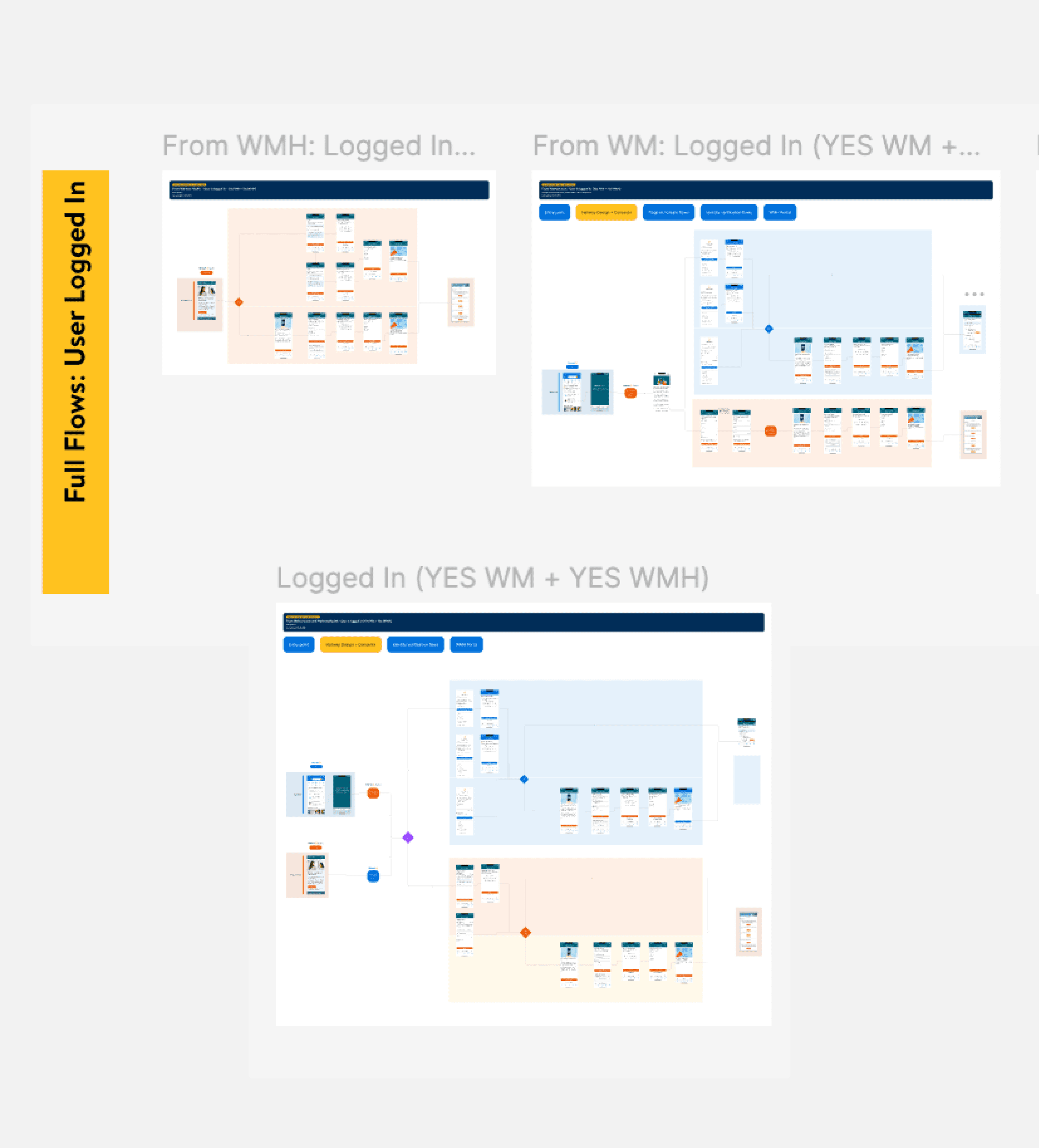
I defined authentication logic, UI variations, and edge-case handling for all user types, delivering wireframes and prototypes aligned with security, compliance, and platform architecture.
The result was a scalable, compliant authentication framework designed to unify the experience without compromising regulatory or technical integrity.
Outcome & Impact
Before transitioning off the project, I delivered a validated direction for a unified authentication experience — grounded in compliance, technical feasibility, and user clarity.
Key outcomes included:
Defined authentication logic across four distinct user types
Secured cross-functional alignment between legal, engineering, and design
Delivered a unified login flow balancing usability with strict security and regulatory constraints
Documented decision rationale, edge cases, and implementation guidelines
Completed structured handoff with detailed specs, prototypes, and next steps
The initiative brought long-standing ambiguity into alignment — accelerating progress on a complex, high-risk area of the product.
As one engineering lead noted:
“It’s amazing how in three months we got closer to the solution than we had in much longer before.”
Beyond the immediate deliverables, the project established a clear, scalable authentication framework — strengthening user trust at a critical entry point while reducing organizational friction around compliance-driven decisions.
Reflection
This project reinforced that authentication — particularly in health contexts — is not just a UX challenge, but a systems challenge shaped by compliance, security, and platform architecture.
Real progress began when legal, engineering, and design aligned around shared trade-offs. Structured cross-functional collaboration reduced ambiguity, accelerated decisions, and transformed a fragmented space into a clear, defensible direction.
Designing within strict regulatory constraints strengthened my ability to balance usability with risk, and to navigate complexity without compromising clarity.
At critical entry points like authentication, simplicity isn’t cosmetic — it’s foundational to user trust.
More Projects
Product Design
UNIFIED LOGIN
Unified login between health and e-commerce sites
Year :
2023
Industry :
Healthcare and E-commerce
Client :
Walmart
Project Duration :
4 months
Problem Statement
CareSmart’s authentication experience was fragmented across separate retail and health login systems, leading to duplicate accounts, user confusion, and recurring access issues.
The business needed a unified login experience — but consolidation required navigating strict legal, security, and platform constraints, as well as complex access logic across multiple user types.
At a critical entry point of the product, authentication was creating friction instead of trust — and required a compliant, scalable solution that balanced usability with regulatory and technical realities.
Approach
To design a sustainable authentication model, I structured the work across three dimensions: user experience, technical feasibility, and legal compliance.
Scenario Mapping
I began by mapping retail and health login flows end-to-end, identifying friction points, edge cases, and system dependencies.
Through this analysis, we identified four distinct user types — each with unique access rules and compliance implications. Clarifying these scenarios exposed the true complexity of the ecosystem and defined the authentication logic required at each stage of the flow.
Strategy Evaluation
Within existing infrastructure constraints, I evaluated three authentication models:
Unify under retail login
Unify under health login
Maintain separate identities based on context
Each option was assessed against usability impact, regulatory risk (health vs. retail data), and backend feasibility.
Cross-Functional Alignment
Recognizing early fragmentation across legal, engineering, and design, I initiated recurring cross-functional sessions to:
Align on compliance requirements
Validate technical constraints
Clarify authentication rules by user type
Reduce ambiguity before implementation
This structured alignment significantly reduced rework and accelerated decision-making.
Solution Definition
I defined authentication logic, UI variations, and edge-case handling for all user types, delivering wireframes and prototypes aligned with security, compliance, and platform architecture.
The result was a scalable, compliant authentication framework designed to unify the experience without compromising regulatory or technical integrity.
Outcome & Impact
Before transitioning off the project, I delivered a validated direction for a unified authentication experience — grounded in compliance, technical feasibility, and user clarity.
Key outcomes included:
Defined authentication logic across four distinct user types
Secured cross-functional alignment between legal, engineering, and design
Delivered a unified login flow balancing usability with strict security and regulatory constraints
Documented decision rationale, edge cases, and implementation guidelines
Completed structured handoff with detailed specs, prototypes, and next steps
The initiative brought long-standing ambiguity into alignment — accelerating progress on a complex, high-risk area of the product.
As one engineering lead noted:
“It’s amazing how in three months we got closer to the solution than we had in much longer before.”
Beyond the immediate deliverables, the project established a clear, scalable authentication framework — strengthening user trust at a critical entry point while reducing organizational friction around compliance-driven decisions.
Reflection
This project reinforced that authentication — particularly in health contexts — is not just a UX challenge, but a systems challenge shaped by compliance, security, and platform architecture.
Real progress began when legal, engineering, and design aligned around shared trade-offs. Structured cross-functional collaboration reduced ambiguity, accelerated decisions, and transformed a fragmented space into a clear, defensible direction.
Designing within strict regulatory constraints strengthened my ability to balance usability with risk, and to navigate complexity without compromising clarity.
At critical entry points like authentication, simplicity isn’t cosmetic — it’s foundational to user trust.
More Projects
Product Design
UNIFIED LOGIN
Unified login between health and e-commerce sites
Year :
2023
Industry :
Healthcare and E-commerce
Client :
Walmart
Project Duration :
4 months
Problem Statement
CareSmart’s authentication experience was fragmented across separate retail and health login systems, leading to duplicate accounts, user confusion, and recurring access issues.
The business needed a unified login experience — but consolidation required navigating strict legal, security, and platform constraints, as well as complex access logic across multiple user types.
At a critical entry point of the product, authentication was creating friction instead of trust — and required a compliant, scalable solution that balanced usability with regulatory and technical realities.
Approach
To design a sustainable authentication model, I structured the work across three dimensions: user experience, technical feasibility, and legal compliance.
Scenario Mapping
I began by mapping retail and health login flows end-to-end, identifying friction points, edge cases, and system dependencies.
Through this analysis, we identified four distinct user types — each with unique access rules and compliance implications. Clarifying these scenarios exposed the true complexity of the ecosystem and defined the authentication logic required at each stage of the flow.
Strategy Evaluation
Within existing infrastructure constraints, I evaluated three authentication models:
Unify under retail login
Unify under health login
Maintain separate identities based on context
Each option was assessed against usability impact, regulatory risk (health vs. retail data), and backend feasibility.
Cross-Functional Alignment
Recognizing early fragmentation across legal, engineering, and design, I initiated recurring cross-functional sessions to:
Align on compliance requirements
Validate technical constraints
Clarify authentication rules by user type
Reduce ambiguity before implementation
This structured alignment significantly reduced rework and accelerated decision-making.
Solution Definition
I defined authentication logic, UI variations, and edge-case handling for all user types, delivering wireframes and prototypes aligned with security, compliance, and platform architecture.
The result was a scalable, compliant authentication framework designed to unify the experience without compromising regulatory or technical integrity.
Outcome & Impact
Before transitioning off the project, I delivered a validated direction for a unified authentication experience — grounded in compliance, technical feasibility, and user clarity.
Key outcomes included:
Defined authentication logic across four distinct user types
Secured cross-functional alignment between legal, engineering, and design
Delivered a unified login flow balancing usability with strict security and regulatory constraints
Documented decision rationale, edge cases, and implementation guidelines
Completed structured handoff with detailed specs, prototypes, and next steps
The initiative brought long-standing ambiguity into alignment — accelerating progress on a complex, high-risk area of the product.
As one engineering lead noted:
“It’s amazing how in three months we got closer to the solution than we had in much longer before.”
Beyond the immediate deliverables, the project established a clear, scalable authentication framework — strengthening user trust at a critical entry point while reducing organizational friction around compliance-driven decisions.
Reflection
This project reinforced that authentication — particularly in health contexts — is not just a UX challenge, but a systems challenge shaped by compliance, security, and platform architecture.
Real progress began when legal, engineering, and design aligned around shared trade-offs. Structured cross-functional collaboration reduced ambiguity, accelerated decisions, and transformed a fragmented space into a clear, defensible direction.
Designing within strict regulatory constraints strengthened my ability to balance usability with risk, and to navigate complexity without compromising clarity.
At critical entry points like authentication, simplicity isn’t cosmetic — it’s foundational to user trust.