Product Design
CLARITYFIRST: FEES
Redesigning different complex experiences for clarity, control, and scale of a commercial real estate transaction platfomr.
Year :
2021
Industry :
Insurance
Client :
First American
Project Duration :
3 years
Problem Statement
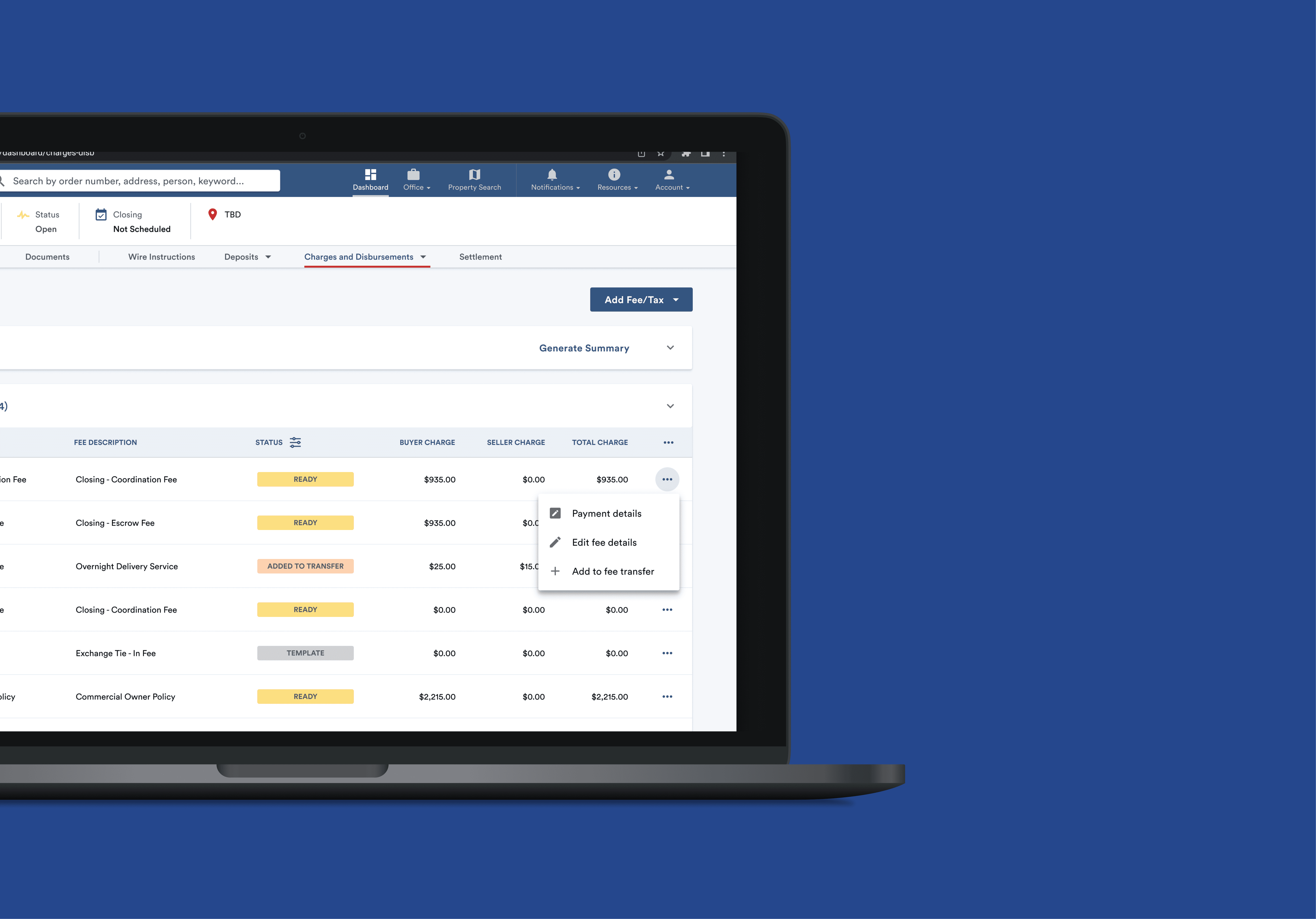
The Fees feature was one of the ClarityFirst's platform most business-critical and complex tools — responsible for managing financial calculations across multiple user roles, permissions, and U.S. state regulations.
Over time, the experience had become difficult to navigate and cognitively heavy. Information architecture lacked clarity, workflows were inefficient, and the interface struggled to balance flexibility with usability. As regulatory and business requirements evolved, the feature became increasingly challenging to scale without adding more complexity.
The organization needed a clearer, more structured fee management experience — one that improved efficiency and user confidence while preserving the flexibility required by role-based permissions and regulatory constraints.
Approach
Cross-Functional Reset
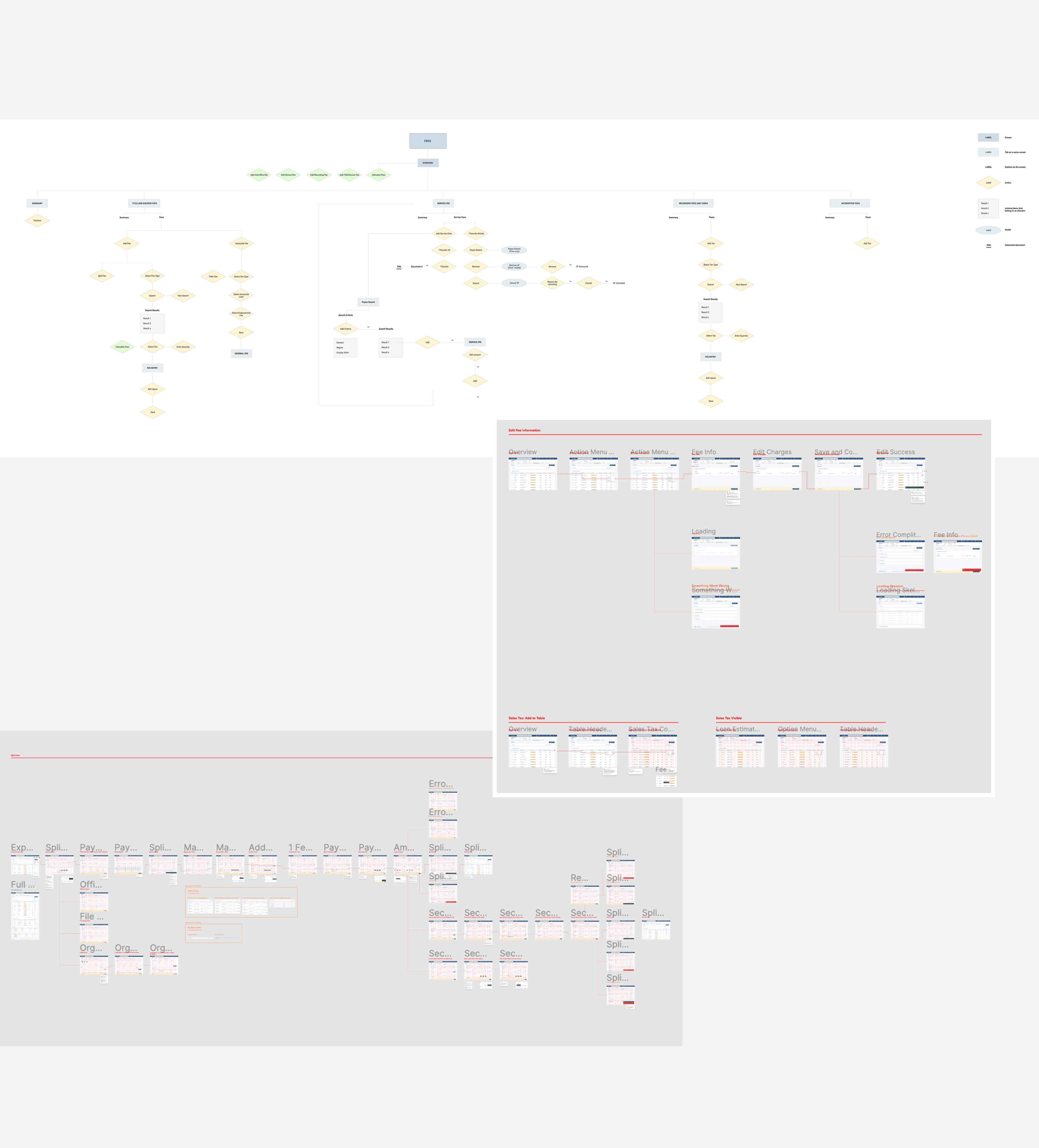
We initiated the redesign with a three-day workshop across Product, Business Analysis, Engineering, and Design to realign on scope, constraints, and user reality.
Through audits and user interviews, we uncovered that the issue wasn’t visual clutter — it was structural misalignment. The Fees feature combined four distinct fee categories, each governed by unique rules, permissions, and state-level regulations. What appeared to be a single-table interface was, in reality, a layered system of workflows and compliance logic.
Information Architecture Redesign
I led a ground-up redefinition of the information architecture.
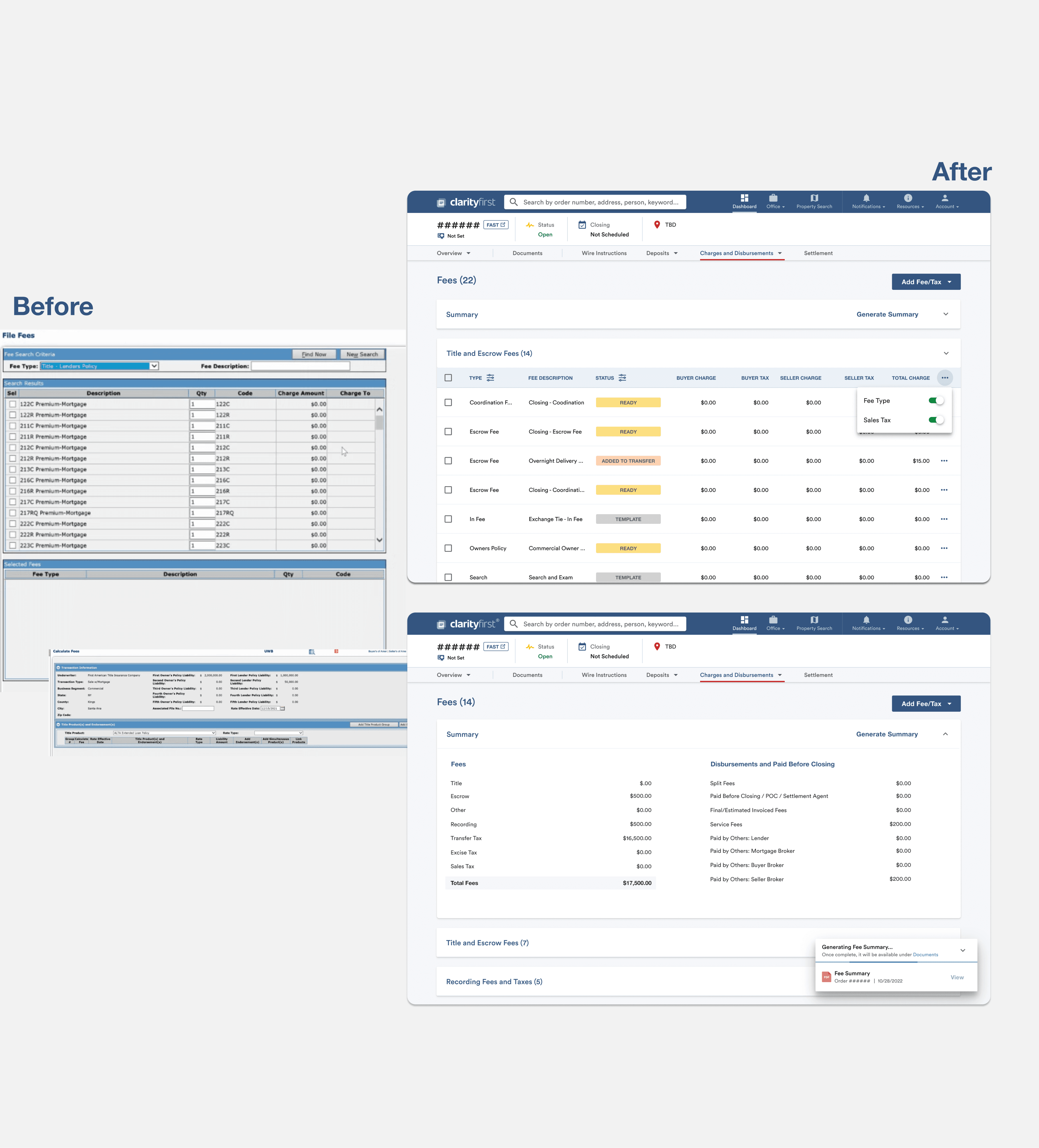
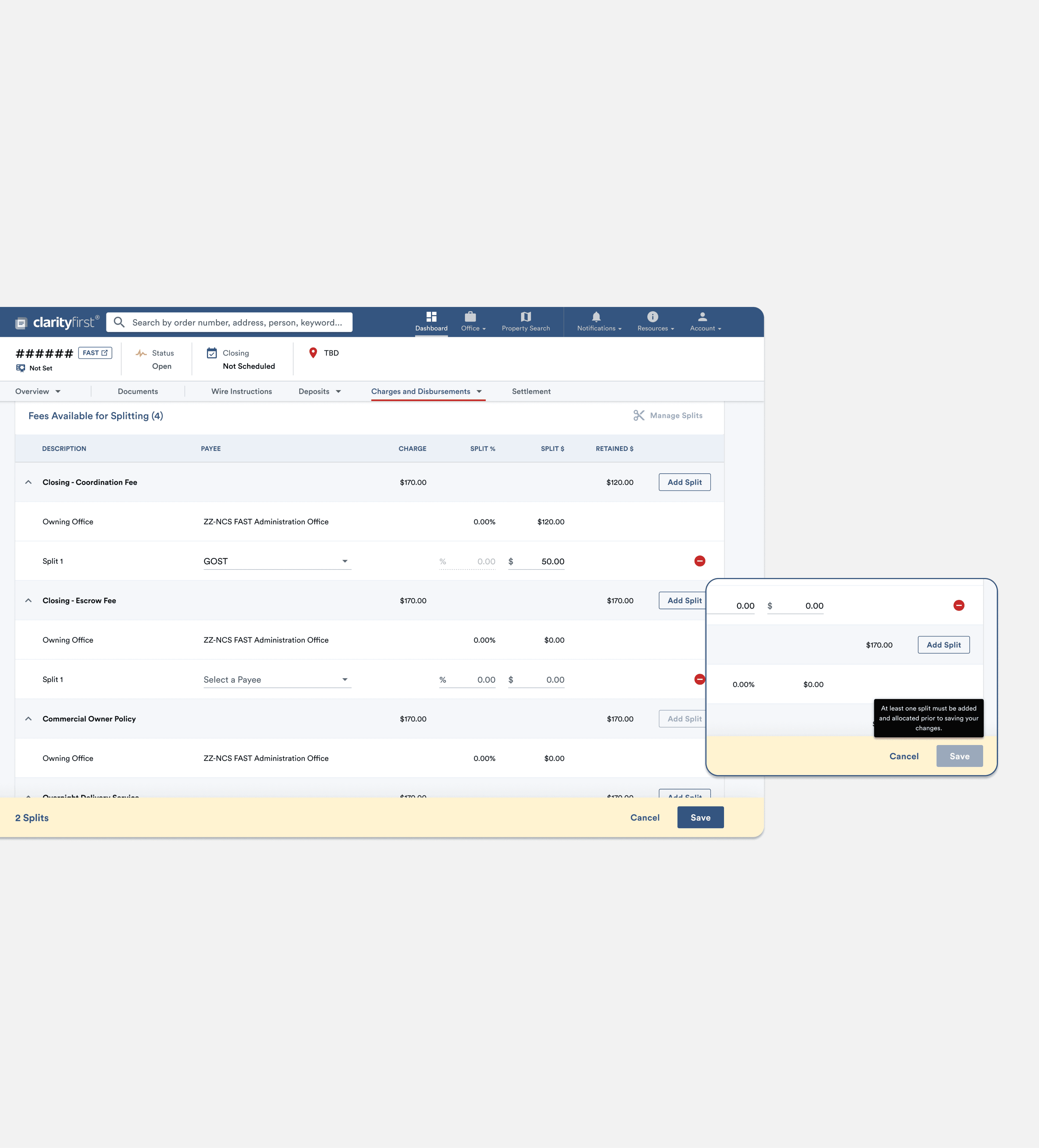
Instead of consolidating everything into one view, we separated the experience into four categorized tables aligned to fee types. This enabled:
Clearer task-based workflows
Role- and state-driven visibility logic
Reduced cognitive overload
Stronger alignment between UI and real operational behavior
The focus was to simplify execution without compromising flexibility or regulatory integrity.
Scalable System Implementation
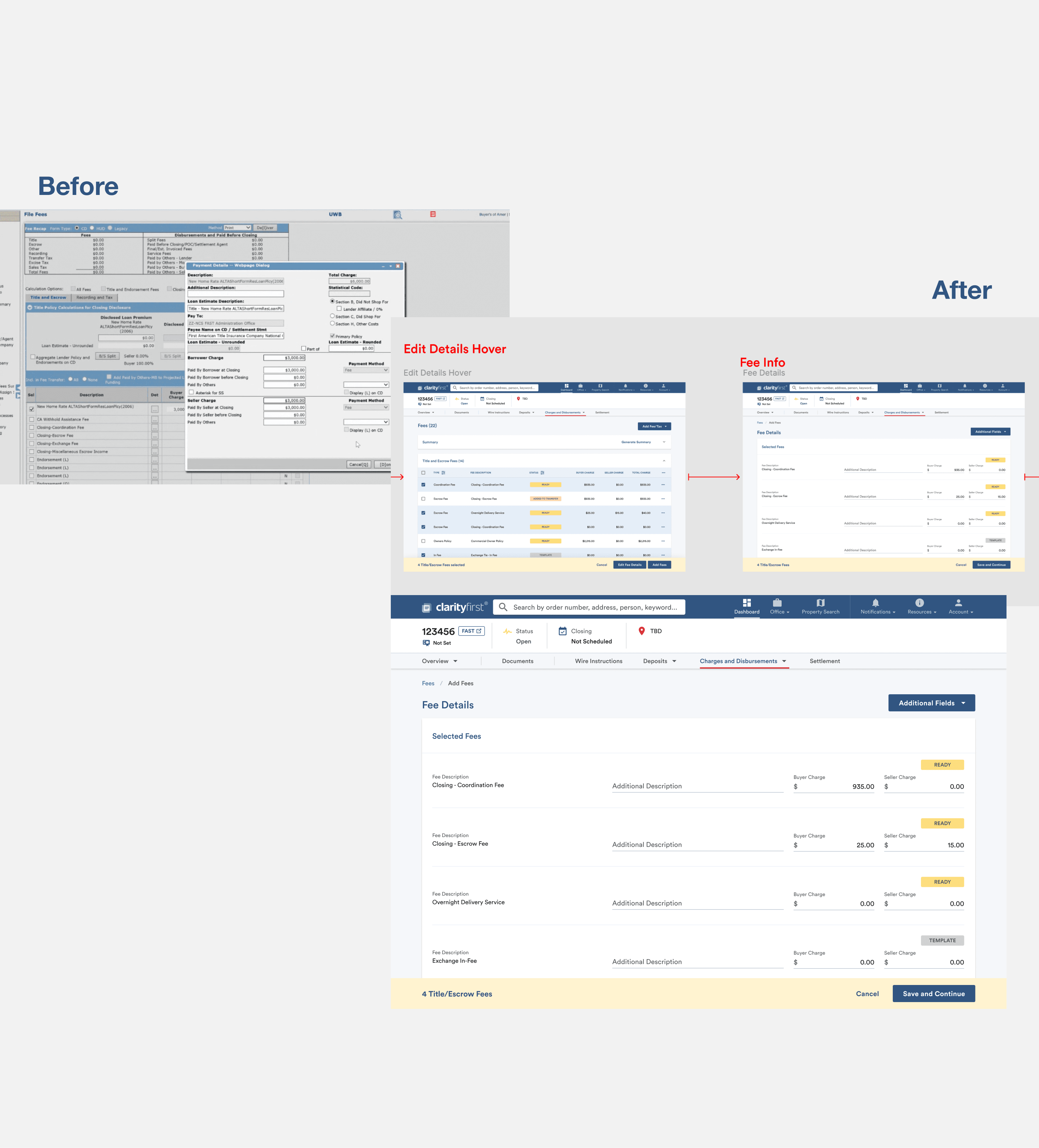
We leveraged and extended the design system to support advanced data interactions, introducing reusable patterns such as:
Editable table cells
Multi-state modals
Configurable table views
All components were designed for scalability, accessibility, and high-volume data efficiency.
Outcome & Impact
The redesign transformed a complex, fragmented financial tool into a structured, scalable system.
Four clearly defined fee categories aligned with real workflows
Simplified execution of six+ critical fee management actions
Role-based visibility protecting sensitive data
Customizable table configurations improving user control
Extended design system supporting future feature growth
Users gained clarity, efficiency, and confidence in managing high-stakes financial data.
The product gained a scalable architectural foundation capable of evolving with regulatory and business complexity.
Redesigning a business-critical financial tool to reduce cognitive load while preserving regulatory flexibility at scale.
Reflections
Financial tools often accumulate complexity as regulations evolve and edge cases multiply. Left unchecked, that complexity surfaces directly in the user experience.
This redesign demonstrated that strategic information architecture and scalable interaction patterns can absorb that complexity — protecting users from cognitive overload while enabling business growth.
Strong product design at this level isn’t about screens — it’s about building systems that can adapt over time.
More Projects


Product Design
CLARITYFIRST: FEES
Redesigning different complex experiences for clarity, control, and scale of a commercial real estate transaction platfomr.
Year :
2021
Industry :
Insurance
Client :
First American
Project Duration :
3 years
Problem Statement
The Fees feature was one of the ClarityFirst's platform most business-critical and complex tools — responsible for managing financial calculations across multiple user roles, permissions, and U.S. state regulations.
Over time, the experience had become difficult to navigate and cognitively heavy. Information architecture lacked clarity, workflows were inefficient, and the interface struggled to balance flexibility with usability. As regulatory and business requirements evolved, the feature became increasingly challenging to scale without adding more complexity.
The organization needed a clearer, more structured fee management experience — one that improved efficiency and user confidence while preserving the flexibility required by role-based permissions and regulatory constraints.
Approach
Cross-Functional Reset
We initiated the redesign with a three-day workshop across Product, Business Analysis, Engineering, and Design to realign on scope, constraints, and user reality.
Through audits and user interviews, we uncovered that the issue wasn’t visual clutter — it was structural misalignment. The Fees feature combined four distinct fee categories, each governed by unique rules, permissions, and state-level regulations. What appeared to be a single-table interface was, in reality, a layered system of workflows and compliance logic.
Information Architecture Redesign
I led a ground-up redefinition of the information architecture.
Instead of consolidating everything into one view, we separated the experience into four categorized tables aligned to fee types. This enabled:
Clearer task-based workflows
Role- and state-driven visibility logic
Reduced cognitive overload
Stronger alignment between UI and real operational behavior
The focus was to simplify execution without compromising flexibility or regulatory integrity.
Scalable System Implementation
We leveraged and extended the design system to support advanced data interactions, introducing reusable patterns such as:
Editable table cells
Multi-state modals
Configurable table views
All components were designed for scalability, accessibility, and high-volume data efficiency.
Outcome & Impact
The redesign transformed a complex, fragmented financial tool into a structured, scalable system.
Four clearly defined fee categories aligned with real workflows
Simplified execution of six+ critical fee management actions
Role-based visibility protecting sensitive data
Customizable table configurations improving user control
Extended design system supporting future feature growth
Users gained clarity, efficiency, and confidence in managing high-stakes financial data.
The product gained a scalable architectural foundation capable of evolving with regulatory and business complexity.
Redesigning a business-critical financial tool to reduce cognitive load while preserving regulatory flexibility at scale.
Reflections
Financial tools often accumulate complexity as regulations evolve and edge cases multiply. Left unchecked, that complexity surfaces directly in the user experience.
This redesign demonstrated that strategic information architecture and scalable interaction patterns can absorb that complexity — protecting users from cognitive overload while enabling business growth.
Strong product design at this level isn’t about screens — it’s about building systems that can adapt over time.
More Projects
Product Design
CLARITYFIRST: FEES
Redesigning different complex experiences for clarity, control, and scale of a commercial real estate transaction platfomr.
Year :
2021
Industry :
Insurance
Client :
First American
Project Duration :
3 years
Problem Statement
The Fees feature was one of the ClarityFirst's platform most business-critical and complex tools — responsible for managing financial calculations across multiple user roles, permissions, and U.S. state regulations.
Over time, the experience had become difficult to navigate and cognitively heavy. Information architecture lacked clarity, workflows were inefficient, and the interface struggled to balance flexibility with usability. As regulatory and business requirements evolved, the feature became increasingly challenging to scale without adding more complexity.
The organization needed a clearer, more structured fee management experience — one that improved efficiency and user confidence while preserving the flexibility required by role-based permissions and regulatory constraints.
Approach
Cross-Functional Reset
We initiated the redesign with a three-day workshop across Product, Business Analysis, Engineering, and Design to realign on scope, constraints, and user reality.
Through audits and user interviews, we uncovered that the issue wasn’t visual clutter — it was structural misalignment. The Fees feature combined four distinct fee categories, each governed by unique rules, permissions, and state-level regulations. What appeared to be a single-table interface was, in reality, a layered system of workflows and compliance logic.
Information Architecture Redesign
I led a ground-up redefinition of the information architecture.
Instead of consolidating everything into one view, we separated the experience into four categorized tables aligned to fee types. This enabled:
Clearer task-based workflows
Role- and state-driven visibility logic
Reduced cognitive overload
Stronger alignment between UI and real operational behavior
The focus was to simplify execution without compromising flexibility or regulatory integrity.
Scalable System Implementation
We leveraged and extended the design system to support advanced data interactions, introducing reusable patterns such as:
Editable table cells
Multi-state modals
Configurable table views
All components were designed for scalability, accessibility, and high-volume data efficiency.
Outcome & Impact
The redesign transformed a complex, fragmented financial tool into a structured, scalable system.
Four clearly defined fee categories aligned with real workflows
Simplified execution of six+ critical fee management actions
Role-based visibility protecting sensitive data
Customizable table configurations improving user control
Extended design system supporting future feature growth
Users gained clarity, efficiency, and confidence in managing high-stakes financial data.
The product gained a scalable architectural foundation capable of evolving with regulatory and business complexity.
Redesigning a business-critical financial tool to reduce cognitive load while preserving regulatory flexibility at scale.
Reflections
Financial tools often accumulate complexity as regulations evolve and edge cases multiply. Left unchecked, that complexity surfaces directly in the user experience.
This redesign demonstrated that strategic information architecture and scalable interaction patterns can absorb that complexity — protecting users from cognitive overload while enabling business growth.
Strong product design at this level isn’t about screens — it’s about building systems that can adapt over time.